
- Fantasy Football Cheat Sheet
- X64 Cheat Sheet
- X86 Registers Cheat Sheet Download
- X86 Registers Cheat Sheet Template
X86/nasm Cheat sheet. Accumulator Register (AX) Counter Register (CX) Data Register (DX) Base Register (DX) Stack Pointer (SP) Stack base Pointer (BP) Source Index (SI) Destination Index (DI) Global Descriptor Table. Supplied by the kernel; Defines the various memory segments, what their size is, what they can access, what level. My x8664 Cheat Sheet. Posted by u/deleted 5 years ago. My x8664 Cheat Sheet. RBP and other registers. If I remember it right, they're 16.
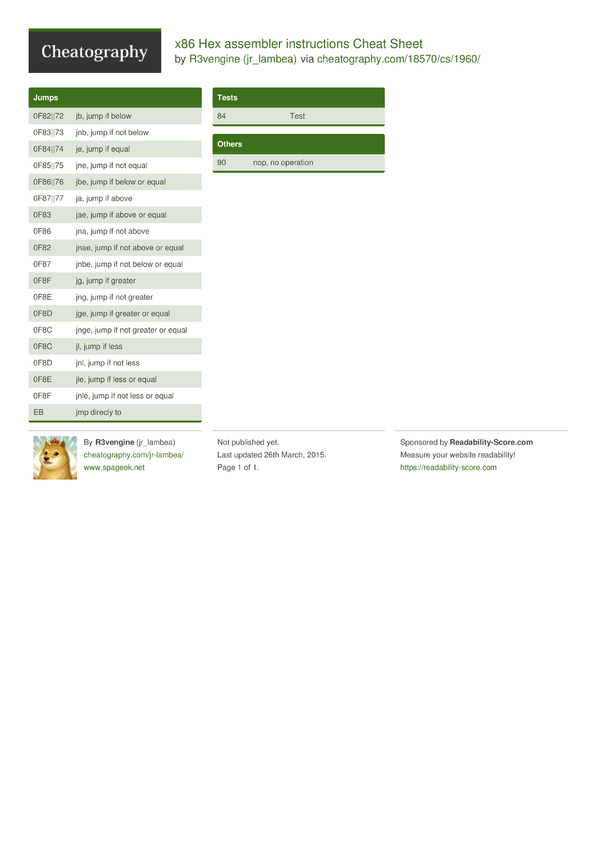
X86 assembly instructions
Browse & Discover Thousands of Computers & Internet Book Titles, for Less.
The x86 instruction set refers to the set of instructions that x86-compatible microprocessors support. The instructions are usually part of an executable program, often stored as a computer file and executed on the processor. The x86 instruction set has been extended several times, introducing wider registers and datatypes as well as new functionality.
Instructions Data Movement Instructions. The mov instruction copies the data item referred to by its second operand (i.e. register Arithmetic and Logic Instructions. The add instruction adds together its two operands, storing the result in its first Control Flow Instructions. The x86 processor
X86 assembly Cheat Sheet
[PDF] x64 Cheat Sheet, x64 Cheat Sheet x64 assembly code uses sixteen 64-bit registers. There are sixteen 64-bit registers in x86-64: %rax, %rbx, %rcx, %rdx, %rdi, %rsi, %rbp,. x86_64 NASM Assembly Quick Reference ('Cheat Sheet') Here's the full list of ordinary integer x86 registers. The 64 bit registers are shown in red. 'Scratch
[PDF] WinDBG x86 Cheat Sheet, X86/WIN32REVERSE ENGINEERING CHEAT-SHEET. Registers. Instructions. GENERAL PURPOSE 32-BIT REGISTERS. ADD <dest>, <source>. x86-64 Assembly Language Summary Dr. Orion Lawlor, last update 2019-10-14 These are all the normal x86-64 registers accessible from user code: Name Notes Type 64-bit long 32-bit int 16-bit short 8-bit char rax Values are returned from functions in this register. scratch rax ea
Fantasy Football Cheat Sheet
[PDF] x86 cheat sheet general purpose registers %eax (%ax,%ah,%al , arithmetic two operand instructions addl src,dst dst = dst + src subl src,dst dst = dst - src imull src,dst dst = dst * src sall src,dst dst = dst << src (aka shll) sarl src x86-cheat-sheet Author: Remzi Arpaci-Dusseau Created Date: 9/25/2012 1:56:03 PM
Assembly language
In computer programming, assembly language (or assembler language), often abbreviated asm, is any low-level programming language in which there is a very strong correspondence between the instructions in the language and the architecture's machine code instructions.
Assembly language is a low-level programming language for a computer or other programmable device specific to a particular computer architecture in contrast to most high-level programming languages, which are generally portable across multiple systems.
So, the low-level assembly language is designed for a specific family of processors that represents various instructions in symbolic code and a more understandable form. Advantages of Assembly Language Having an understanding of assembly language makes one aware of − How programs interface with OS, processor, and BIOS;
X86 registers
X64 Cheat Sheet
32-bit x86 processors (starting with the 80386) also include various special/miscellaneous registers such as control registers (CR0 through 4, CR8 for 64-bit only), debug registers (DR0 through 3, plus 6 and 7), test registers (TR3 through 7; 80486 only), and model-specific registers (MSRs, appearing with the Pentium).
x86 Registers The main tools to write programs in x86 assembly are the processor registers. The registers are like variables built in the processor. Using registers instead of memory to store values makes the process faster and cleaner.
Inside the CPU, there exists a small piece of memory called registers. Registers are extremely fast, because it can be directly accessed by the CPU. Modern x86–64 processors have 16 general-purpose
X86 assembly Hello World
x86 Assembly Language Programming, Writes 'Hello, World' to the console using only system calls. Runs on 64-bit Linux only. ; To assemble and run: ; ; nasm -felf64 hello.asm && ld hello.o && ./a.out If you would like to support me, please like, comment & subscribe, and check me out on Patreon: https://patreon.com/johnhammond010E-mail: johnhammond010@gmai
x86 Assembly: Hello World!, This is the usual shortest-possible 16-bit version, depending on the DOS Services print-string function (function 9). A slight expansion, using DOS Services's print-character function (function 2) as well. Hello world in Linux x86-64 assembly A “hello world” program writes to stdout (calling write) then exits (calling exit). The assembly program hello.s below does that on Linux x86-64.
'Hello, World' in x86 Assembly Language, A program must have at least .text section. Now we will write our first program. Here is sample code: 6.2.2. NASM (hello.asm) Writing an x86 “Hello world” boot loader with assembly. To make our lives a little easier (sic!) and make it all more fun, we will use x86 assembly language for our boot loader. The
X86 assembly example
MASM uses the standard Intel syntax for writing x86 assembly code. The full x86 instruction set is large and complex (Intel's x86 instruction set manuals comprise over 2900 pages), and we do not cover it all in this guide. For example, there is a 16-bit subset of the x86 instruction set. Using the 16-bit programming model can be quite complex.
We will uses the standard AT&T syntax for writing x86 assembly code. The full x86 instruction set is large and complex (Intel's x86 instruction set manuals comprise over 2900 pages), and we do not cover it all in this guide. For example, there is a 16-bit subset of the x86 instruction set. Using the 16-bit programming model can be quite complex.
Below is an example of machine code in hexadecimal form for generating fibonacci series terms. X86 machine code Just as we can't really understand machine code, a computer processor can't really understand our language, that's where Assembly Language comes into play.
X86 assembly tutorial
Guide to x86 Assembly - Computer Science, Guide to Using Assembly in Visual Studio — a tutorial on building and debugging assembly code in Visual Studio; Intel x86 Instruction Set Guide to Using Assembly in Visual Studio — a tutorial on building and debugging assembly code in Visual Studio Intel x86 Instruction Set Reference; Intel's Pentium Manuals (the full gory details) Registers. Modern (i.e 386 and beyond) x86 processors have eight 32-bit general purpose registers, as depicted in Figure 1.
Assembly Programming Tutorial, Using various string instructions: movs, lods, cmps, scas, and stos. Using structures like the ones in high-level languages. The structure in assembly is equivalent to struct in C/C++ and record in Pascal. Addressing modes and memory modes explained plus Computer Architecture 101. Welcome to first video of x86 Assembly course. In this video we will see Introduction and Architecture. We will start with Numbering Systems then move onto D
A fundamental introduction to x86 assembly programming, Assembly Language Overview. ○ Registers, Flags, Memory Addressing, Instructions,. Stack / Calling Convention. ○ BIOS. ○ Quick kernel If you would like to support me, please like, comment & subscribe, and check me out on Patreon: https://patreon.com/johnhammond010E-mail: johnhammond010@gmai
X86 assembler online
Online x86 and x64 Intel Instruction Assembler, Online x86 / x64 Assembler and Disassembler. This tool takes x86 or x64 assembly instructions and converts them to their binary representation (machine code). Online x86 / x64 Assembler and Disassembler. This tool takes x86 or x64 assembly instructions and converts them to their binary representation (machine code). It can also go the other way, taking a hexadecimal string of machine code and transforming it into a human-readable representation of the instructions. It uses GCC and objdump behind the scenes.

Compile Asm Online, Online Asm Compiler, Online Asm Editor, Online Asm IDE, Asm Coding Online, Practice Asm Online, Execute Asm Online, Compile Asm Online, Run Asm Online Assembler and Disassembler. Online wrappers around the Keystone and Capstone projects. ARM ARM Sparc x86 (16) x86 (32) x86 (64)
Online Assembler and Disassembler, Online wrappers around the Keystone and Capstone projects. ARM ARM (thumb) AArch64. Mips (32) Mips (64) PowerPC (32) PowerPC (64) Sparc x86 (16) x86 JDoodle is a free Online Compiler, Editor, IDE for Java, C, C++, PHP, Perl, Python, Ruby and many more. you can run your programs on the fly online and you can save and share them with others. Quick and Easy way to compile and run programs online.
X86 assembly registers
X86 Assembly/X86 Architecture, Modern (i.e 386 and beyond) x86 processors have eight 32-bit general purpose registers, as depicted in Figure 1. The register names Modern (i.e 386 and beyond) x86 processors have eight 32-bit general purpose registers, as depicted in Figure 1. The register names are mostly historical. For example, EAX used to be called the accumulator since it was used by a number of arithmetic operations, and ECX was known as the counter since it was used to hold a loop index.
Guide to x86 Assembly - Computer Science, Data Registers · AX is the primary accumulator; it is used in input/output and most arithmetic instructions. · BX is known as the base register, as it could be used in When Intel expanded the x86 architecture to 32 bits in 1986, it doubled the size of all eight registers and gave them new names by prefixing an E in front of each register name, resulting in EAX, EBX, ECX, EDX, EBP, ESI, EDI, and ESP. With x86_64 came another doubling of register size, as well as the addition of some new registers.
Assembly - Registers, The main tools to write programs in x86 assembly are the processor registers. General registers EAX EBX ECX EDX Segment registers CS DS ES FS GS SS The main tools to write programs in x86 assembly are the processor registers. The registers are like variables built in the processor. Using registers instead of memory to store values makes the process faster and cleaner. The problem with the x86 serie of processors is that there are few registers to use.
Error processing SSI fileArray in assembly x86
Assembly - Arrays, Assembly - Arrays - We have already discussed that the data definition directives to the assembler are used for allocating storage for variables. The variable The AT&T syntax is used by the GNU assembler. The directive you're looking for is .fill <count> [, <data-size> [, <value>]]. In the specific case of 400 bytes: array: .fill 400. data-size defaults to 1 (byte). I believe the value that fills the 400 bytes defaults to zero.
Assembly x86 putting values into array with loop, myArray = 0, 1, 2, 3, 4, 5, 6, 7, 8, 9. These are the numbers that you want your array to contain. But since you initialized the index variable (that you will be using Assembly - Arrays - We have already discussed that the data definition directives to the assembler are used for allocating storage for variables. The variable could also be initial
[PDF] x86 ARRAYS, Optimizing compilers are very good at optimizing array indexing code. ▸ As a result, output may not look at all like the input. ARRAYS IN ASSEMBLY. 11 Unlike in high level languages where arrays can have many dimensions and are accessed by indices, arrays in x86 assembly language are simply a number of cells located contiguously in memory. An array can be declared by just listing the values, as in the first example below.
Error processing SSI fileAssembly code
Assembly language, Advantages of Assembly Language · How programs interface with OS, processor, and BIOS; · How data is represented in memory and other external devices; · How Assembly language is a low-level programming language for a computer or other programmable device specific to a particular computer architecture in contrast to most high-level programming languages, which are generally portable across multiple systems. Assembly language is converted into executable machine code by a utility program referred to as an assembler like NASM, MASM, etc.
Assembly - Introduction, Assembly Programming Tutorial - Assembly language is a low-level machine code by a utility program referred to as an assembler like NASM, MASM, etc. Program code to Find the Size of a Union C Define the union named sample. Declare three variables m, n and ch of different data types. Use the keyword sizeof() to find the size of a union and print the same. Initialize C program code to set nth bit of a number We use bitwise OR | operator to set any bit of a number.
Assembly Programming Tutorial, GCD Program Assembly Code. The code generation phase of a compiler translates the intermediate form into the target language. Given the information contained To assemble the program, type nasm -f elf hello.asm. If there is any error, you will be prompted about that at this stage. Otherwise, an object file of your program named hello.o will be created. To link the object file and create an executable file named hello, type ld -m elf_i386 -s -o hello hello.o.
Error processing SSI fileMore Articles
The cheat sheet is intended for 32-bit Windows programming with FASM. One A4 page contains almost all general-purpose x86 instructions (except FPU, MMX and SSE instructions).
What is included
You will find various kinds of moves (MOV, CMOV, XCHG), arithmetical (ADD, SUB, MUL, DIV) and logical (AND, OR, XOR, NOT) instructions here. Several charts illustrate shifts (SHL/SHR, ROL/ROR, RCL/RCR) and stack frames. Code samples for typical high-level language constructs (if conditions, while and for loops, switches, function calls) are shown. Also included are quick references for RDTSC and CPUID instructions, description of string operations such as REP MOVSB, some code patterns for branchless conditions, a list of registers that should be saved in functions, and a lot of other useful stuff.
The idea is to put all reference information about x86 assembly language on the one page. Some rarely-used instructions such as LDS, BOUNDS or AAA are skipped.
Notation
The cheat sheet use common notation for operands: reg means register, [mem] means memory location, and imm is an immediate operand. Also, x, y, and z denote the first, the second, and the third operand. Instruction mnemonics are written in capital letters to make them easier to find when you are skipping through the cheat sheet.
Example
For example, let's look at multiplication and division section. There are instructions for signed (IMUL) and unsigned (MUL) multiplication. Both instructions take one operand, which may be register (reg) or memory ([mem]). There are three possible cases:
X86 Registers Cheat Sheet Download
- If operand size is one byte, MUL or IMUL multiplies it by al and stores the result in ax
- If operand size is a word, MUL or IMUL multiplies it by ax and stores the high-order word of the result in dx and the low-order word in ax.
- If operand size is a double word, MUL or IMUL multiplies it by eax and stores the high-order dword in edx and the low-order dword in eax.
There are also two-operand and three-operand forms of IMUL shown on the figure above.
Other features of assembly language are described in a similar way.
Download
X86 Registers Cheat Sheet Template
The cheat sheet is designed for A4 page size; if you print it on US Letter paper, you will get large margins. You can print the cheat sheet and put it on your table to look for some instructions when you forget them.
Serbo-Croatian translation of this article by WHG Team.